
Knowledge Libraries
Summary
Knowledge libraries are composable and reusable, indexed, searchable sets of canonical guidance for coding agents.
Zeeq knowledge libraries surface telemetry that allows teams to see where agents are activating guidance and using sourcing context.
These libraries should contain invariants across your codebase: logging and telemetry, advanced usage of platform and language features, database access patterns, API surface area design, workflows and processes, etc.
Because the libraries are server-rendered, they never need to sync or be updated for the local coding agents; they are always up-to-date and instantly propagated to connected clients.
Libraries aren't just used by the local coding agents, the same content feeds into the code reviews so the code reviews have the effect of being a backstop ** that ensures consistency and compliance.
Current supported providers:
- GitHub: public and private repositories, including GitHub Enterprise Server
- Notion: public and private workspaces
Composition of libraries
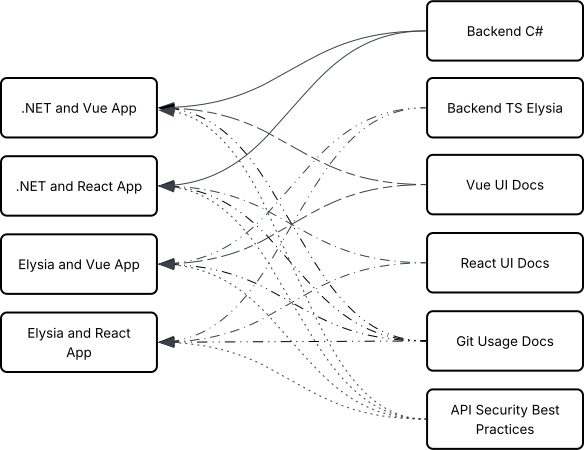
Library composition is an especially powerful concept as this fits well in:
- Microservices architectures where services may need to know about how to use other services without the need to synchronize reference content between repositories
- Platform-oriented architectures where code relies on shared platform packages like front-end component libraries, shared theming and CSS, and shared back-end platform libraries
In this type of application, Zeeq's virtual libraries make composition of knowledge simple:
<!-- Example AGENTS.md once the harness is connect to the MCP -->
Use the following libraries from Zeeq when working in this codebase:

|Library|Purpose|
|--|--|
|`zeeq-app`|(Primary) Canonical coding style, technical best practices, implementation patterns|
|`zeeq-docs`|(Secondary) Architecture, product design, features, user guide|
|`zeeq-ui`|Use when working on `*.vue` files|
This makes it easy to achieve high levels of consistency across a portfolio of codebases by easily reusing canonical guidance and best practices across an organization.
Indexing and search
Zeeq doesn't just store documents, content is indexed and optimized for search. It takes advantage of both Postgres text search (full text, trigram, fuzzy string match) as well as specially constructed vector embeddings to improve recall.
The indexing strategy uses a specially constructed text block to feed into the embedding which allows higher recall and retrieval rates.
Content chunking: sections
When Zeeq indexes content, it parses out sections of the document and can serve those independently, cutting across multiple documents in your system to let agents find the best match.
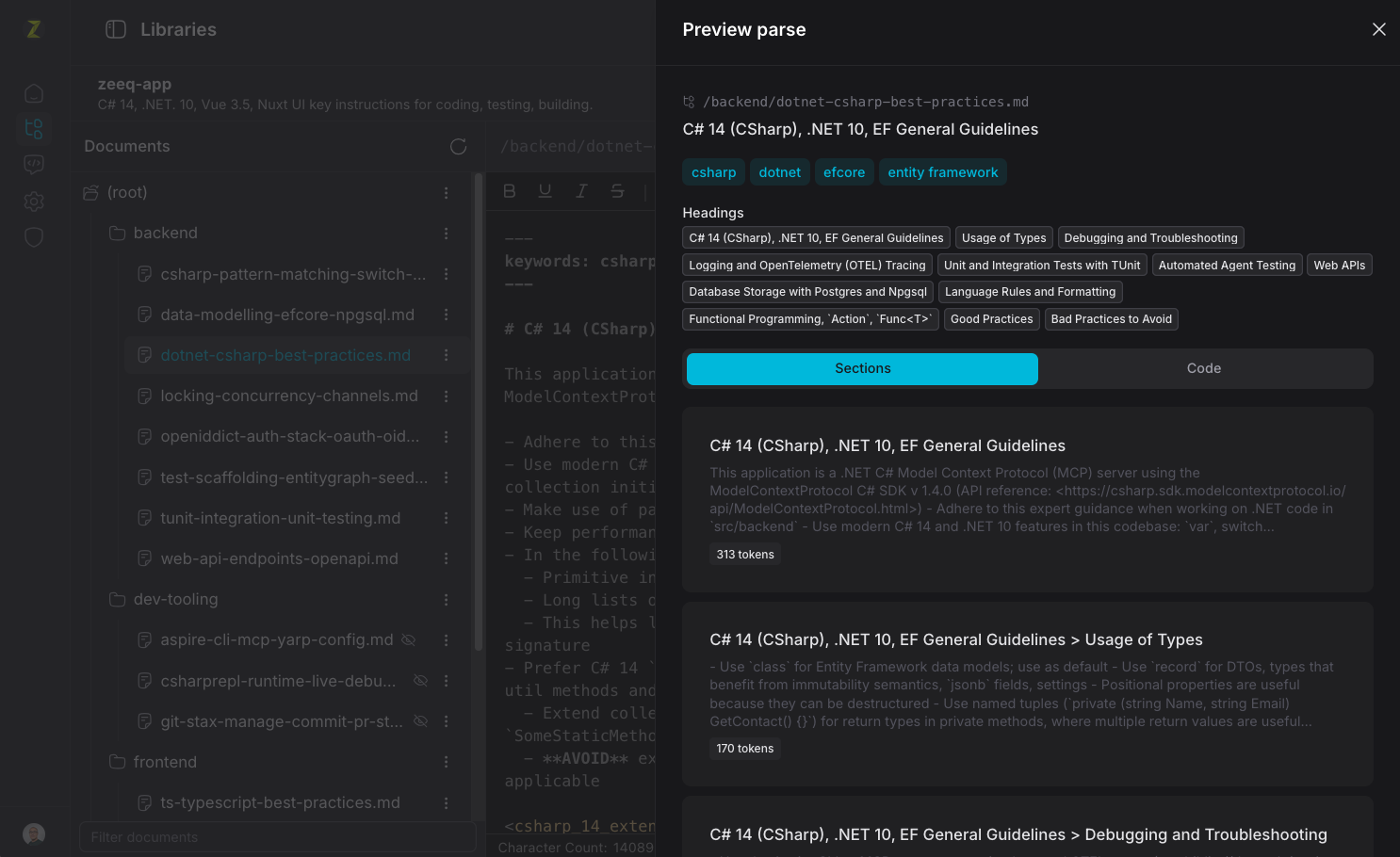
This allows agents to efficiently search for semantic sections of the document most relevant to its task.
Content chunking: code snippets
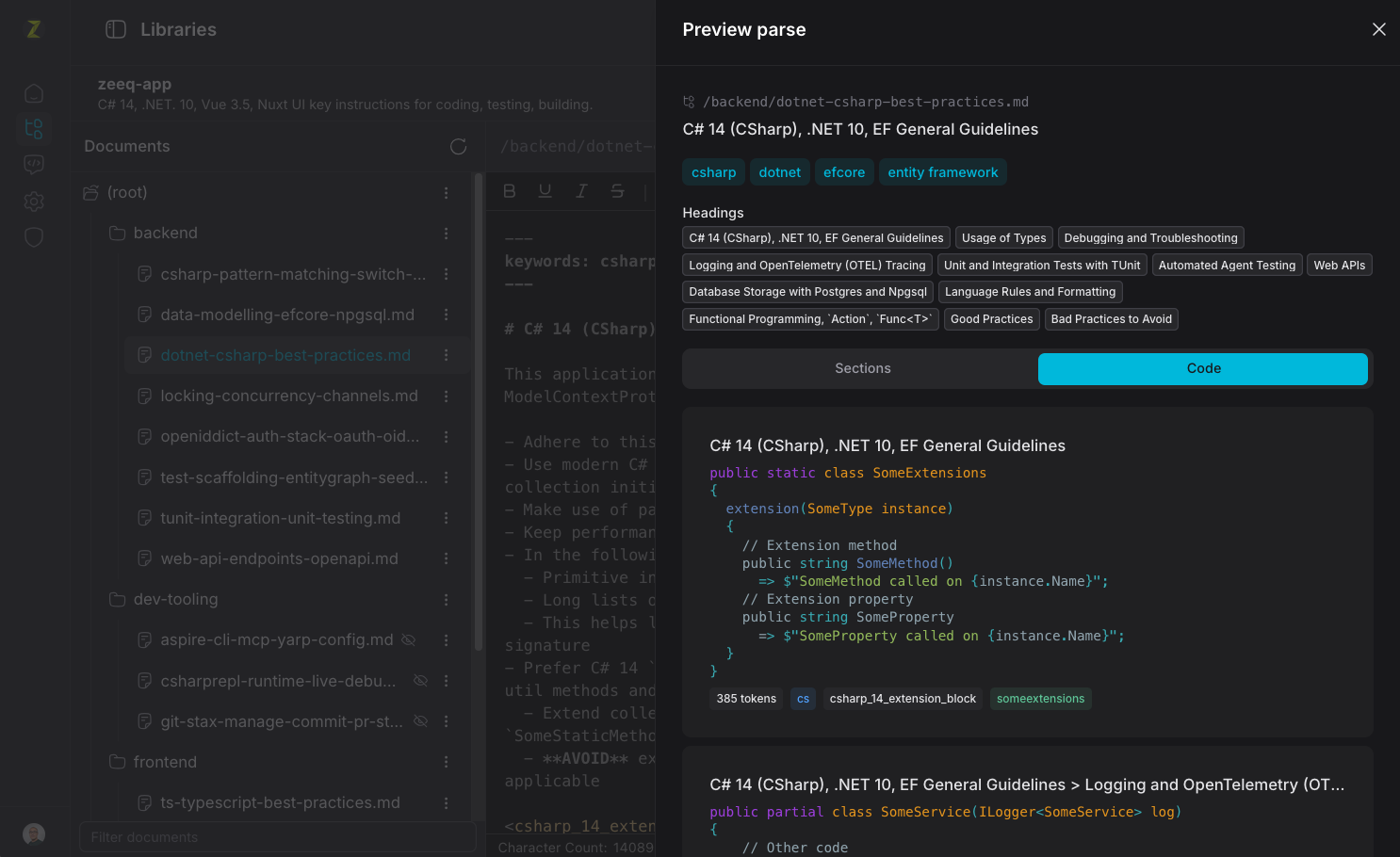
Likewise, each code snippet in your documents is separated out and can be searched and served independently.
These canonical snippets help agents know how to produce code following your desired patterns. This is especially important for platform level code like logging, telemetry, error handling, data access, concurrency, rate limiting, input validation, API surface area design, and so on.
Document telemetry
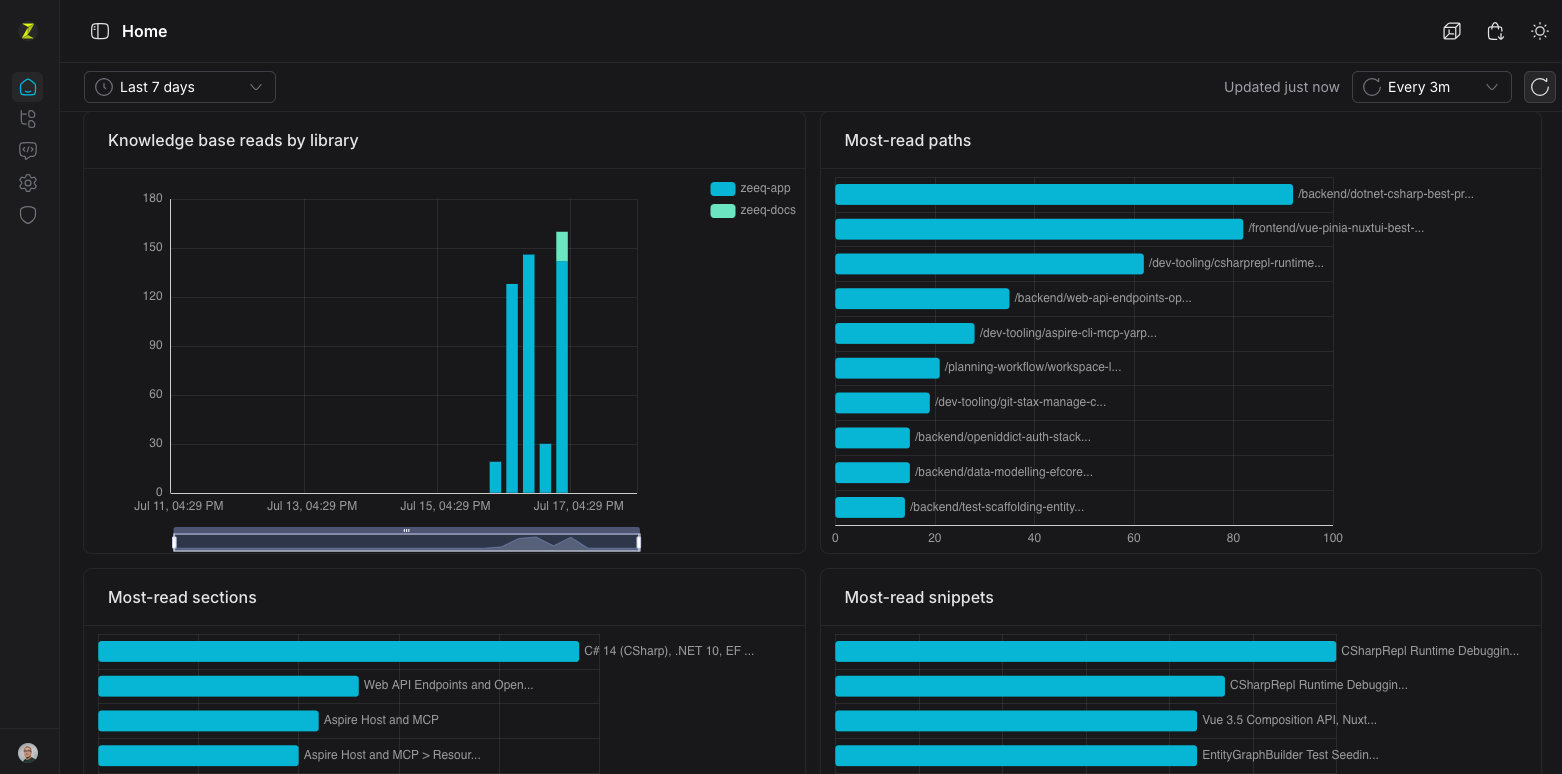
Because Zeeq serves documents via remote MCP tool interfaces, it can capture detailed telemetry about which documents are high-leverage across your org.
This is a key observability feedback loop that lets your most senior engineers understand where to focus their efforts in writing canonical standards that show agents how to write code that adheres to the desired organizational objectives (performance, consistency, security, error handling, and other patterns and practices).
Additional background
There's also some research that suggests separating local context from code helps agents perform better.
(12 Feb 2026) Evaluating AGENTS.md: Are Repository-Level Context Files Helpful for Coding Agents?
Across multiple coding agents and LLMs, we find that context files tend to reduce task success rates compared to providing no repository context, while also increasing inference cost by over 20%... Ultimately, we conclude that unnecessary requirements from context files make tasks harder, and human-written context files should describe only minimal requirements.
Key takeaway: local context files in the repository pollute the local search space and reduces agent performance since agents searching for code will also read incidental matches in the context files that may or may not be canonical.
(01 Oct 2025) Affordable AI Assistants with Knowledge Graph of Thoughts
Knowledge Graph of Thoughts (KGoT) extracts and structures task-relevant knowledge into a dynamic KG representation, iteratively enhanced through external tools such as math solvers, web crawlers, and Python scripts. Such structured representation of task-relevant knowledge enables low-cost models to solve complex tasks effectively while also minimizing bias and noise. For example, KGoT achieves a 29% improvement in task success rates on the GAIA benchmark compared to Hugging Face Agents with GPT-4o mini.
Key Takeaway: advanced context retrieval techniques can improve speed, performance, and context efficiency for coding agents while improving task success rates. Regardless of improvements in the agents, tighter, focused context will always yield performance improvements in speed and task adherence.