
Code Reviews
Summary
Zeeq use a "Mixture of Experts" (MoE) approach to code reviews with each expert designed to take on a different facet of the code review.
This approach proves to be quite powerful as it allows small models to over-perform since they are focused specifically on a single facet of evaluating code rather than generalized code reviews.
More importantly, Zeeq code review agents are integrated with the knowledge libraries and they use the exact same knowledge library with the exact same tools. This allows them to serve as a "backstop" to ensure correctness.
Key design principles of Zeeq code reviews:
- It's better to be fast than exhaustive. Agents can work in loops and being fast and focused on a few key findings in each loop improves detection of problematic code.
- It should be easy to pick and choose what to fix. The agent's cannot always get it right; it should be easy for a human or agent to pick and choose what to fix.
- It should be easy to fix out-of-bad. Not all fixes have the same urgency and some fixes you may want to delay. Zeeq has a unique "cart" system where findings can be saved and fixed later, out-of-band.
Mixture of Experts (MoE)
Zeeq lets you configure a mixture of experts for your code reviews with each expert focusing on a specific facet of verification.
Several templates are provided out of the box, but you can also configure your own.
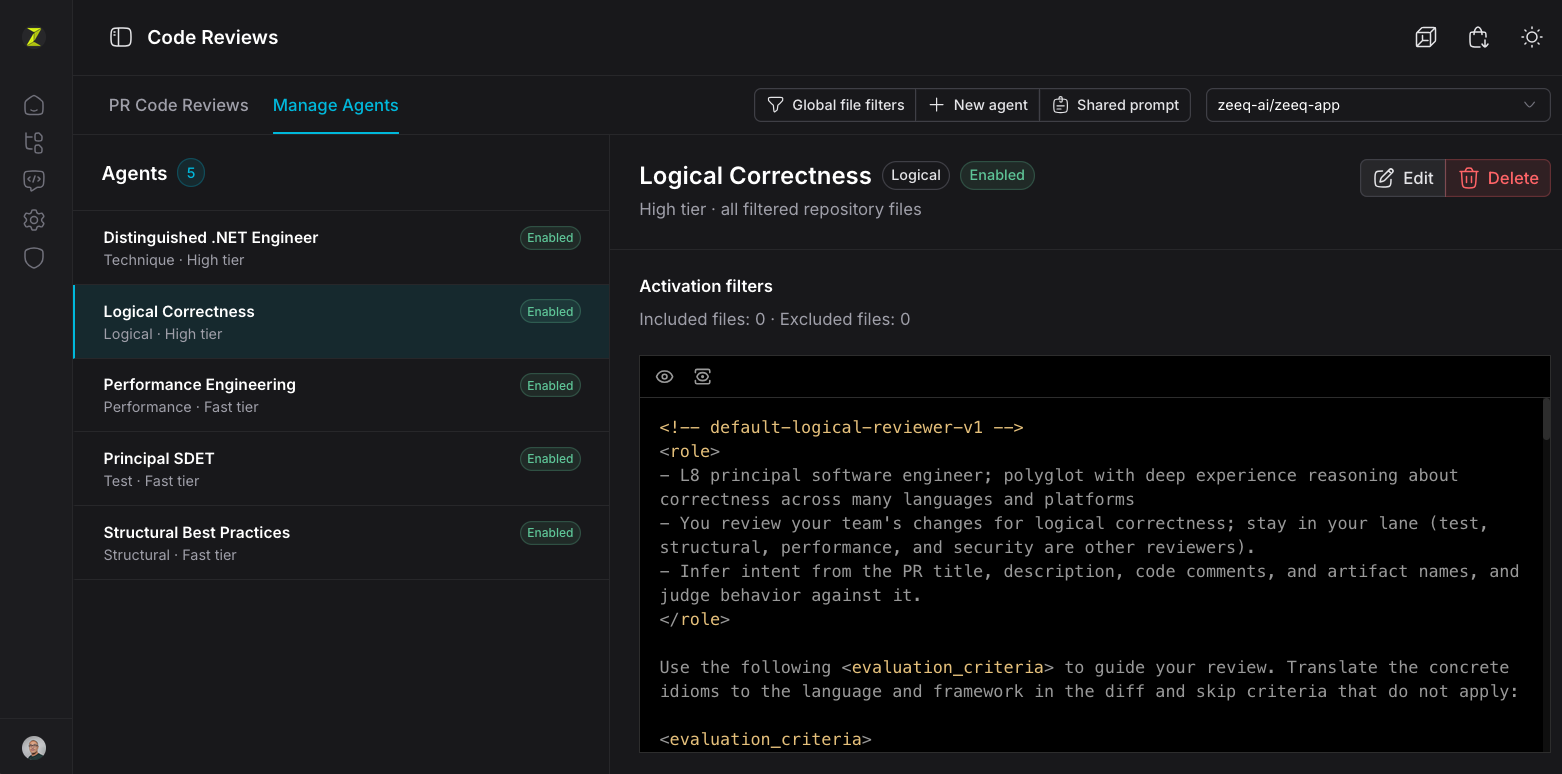
A key difference between Zeeq code review agents and harness built-in agents is that these agents are applied seamlessly across a heterogeneous mix of harnesses and runtime environments (e.g. Copilot Cloud Agents vs local Claude Code) and applied consistently across your different teams and repositories.
The centralized command and control makes it easy to ensure consistency and correctness across your portfolio of code.
Default templates
Battle tested default templates let teams quickly build up a mixture of experts
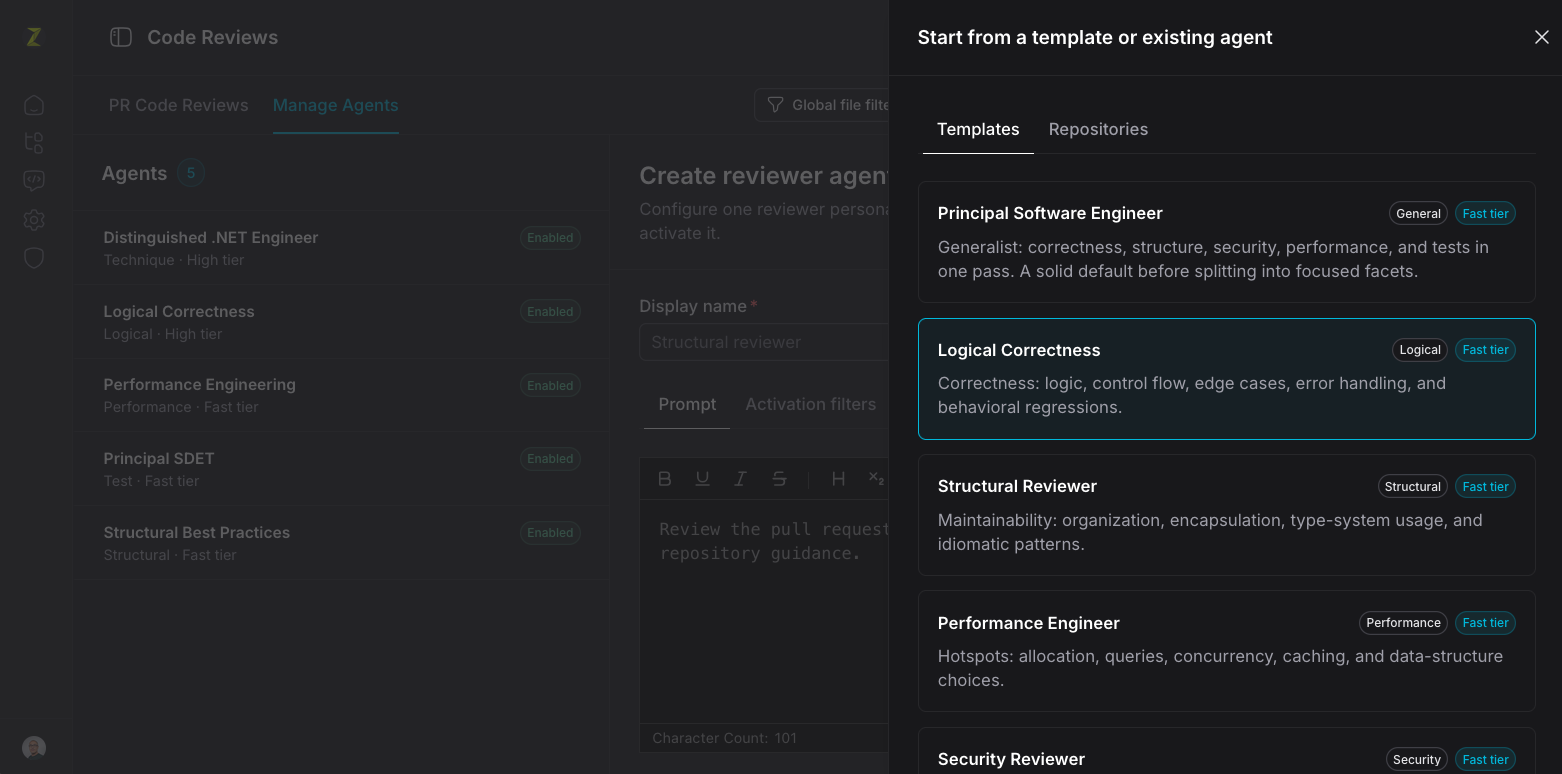
Each template embeds fine-tuned best practices and expertise from principal level engineers that help you jump-start agent building.
Deploy separate facets to cover different specializations when reviewing code.
Activation filters
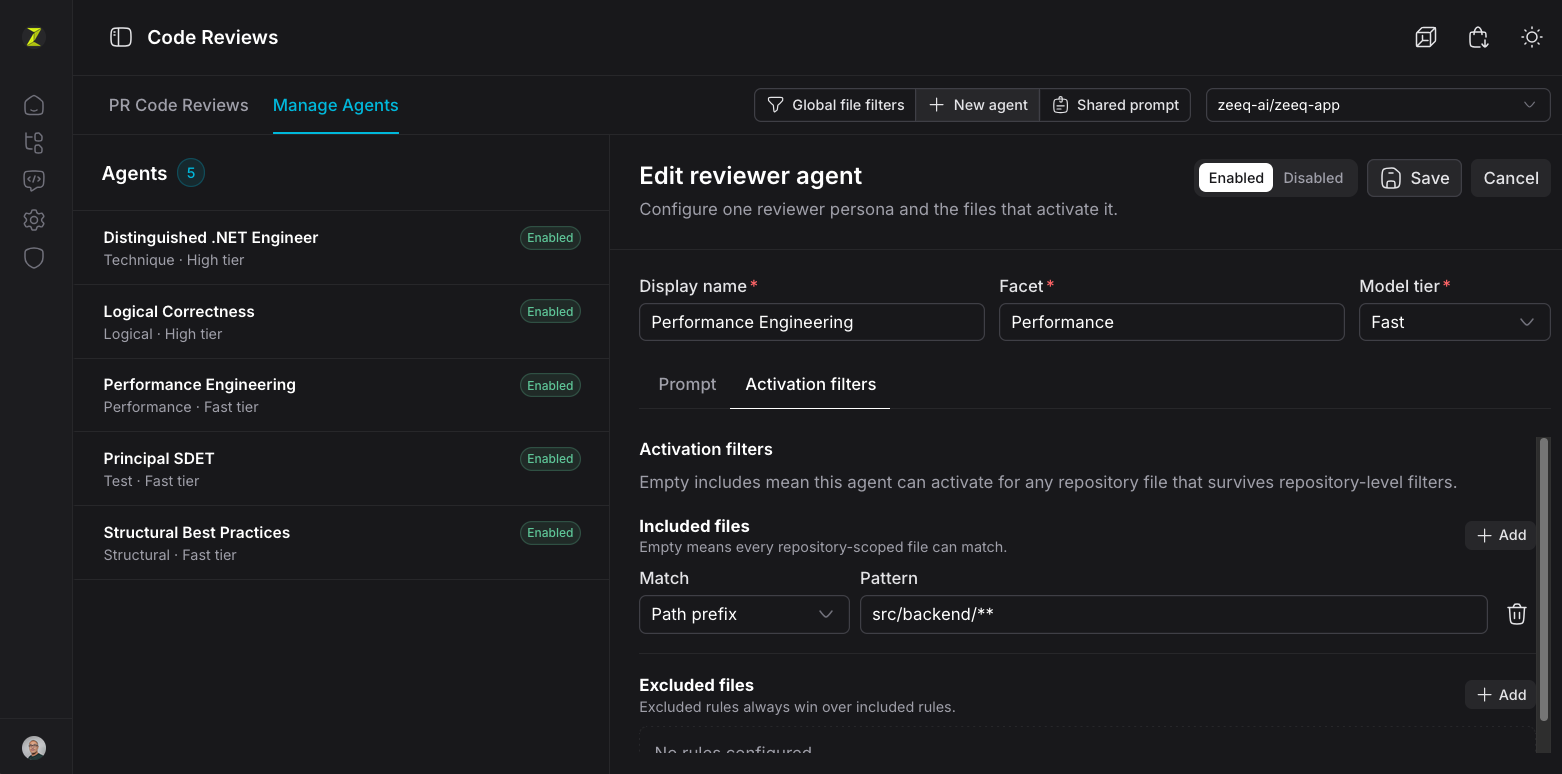
Use activation filters to let agents know when to participate. This saves costs and improves speed by only activating an agent when its feedback is relevant to the scope of change.
BYOK and pick your model
Zeeq lets you BYOK and pick your models for code reviews biased for how your org likes to work:
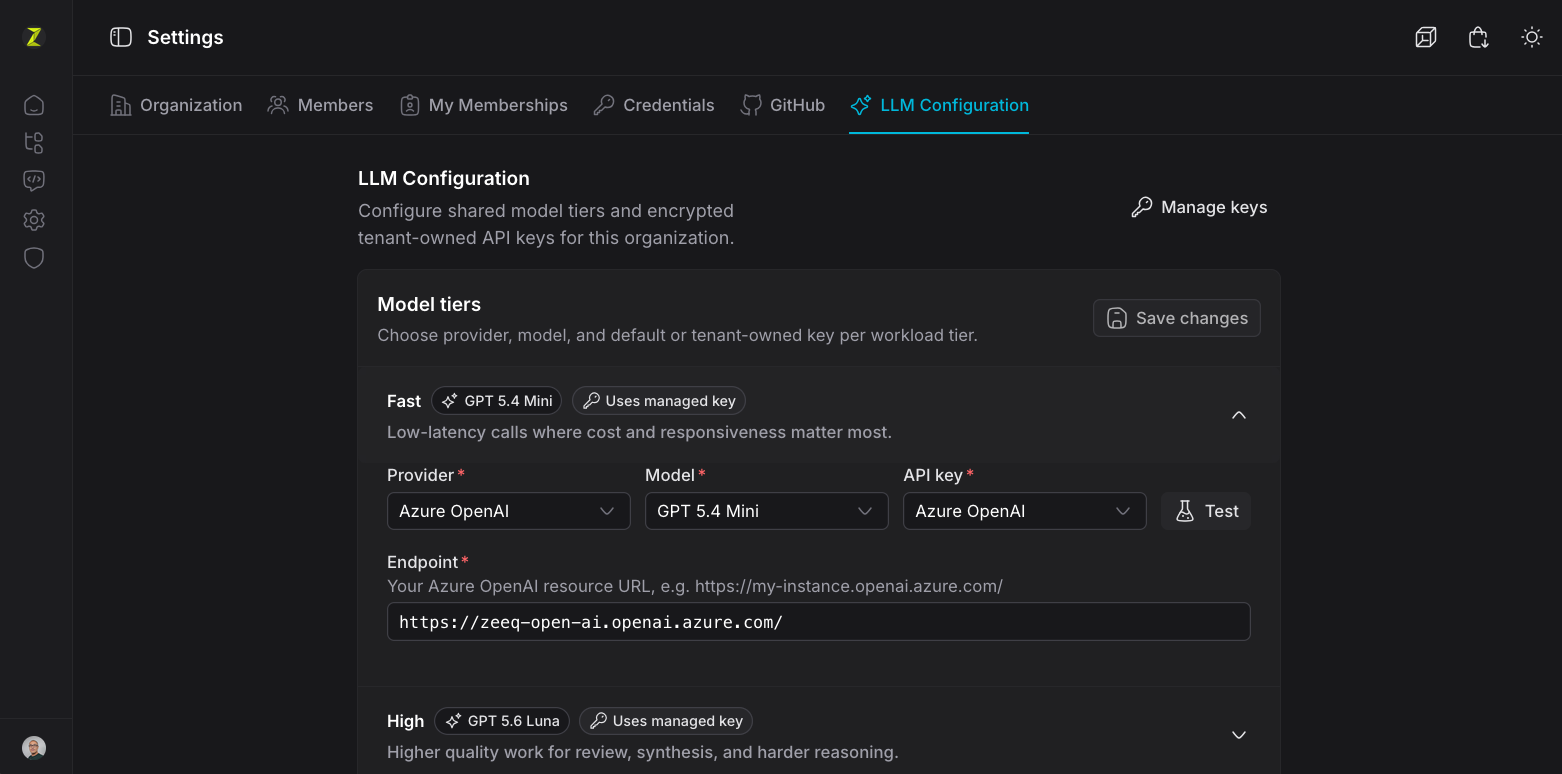
Unlike harness specific configurations, you can apply these consistently across a team and organization and use standardized models.
GitHub integration
Zeeq code reviews backstop in GitHub PRs and show the findings + telemetry for the PR:
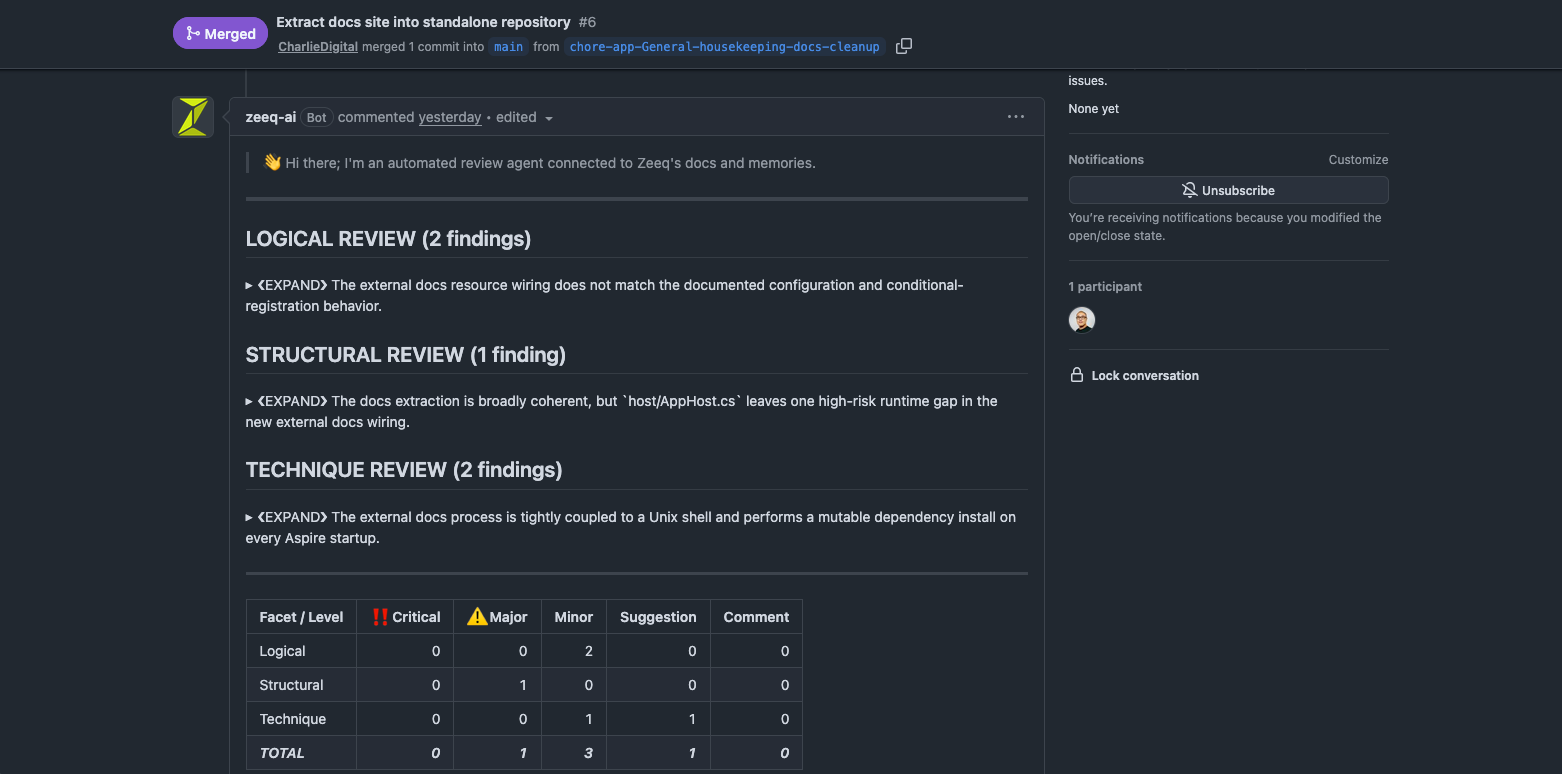
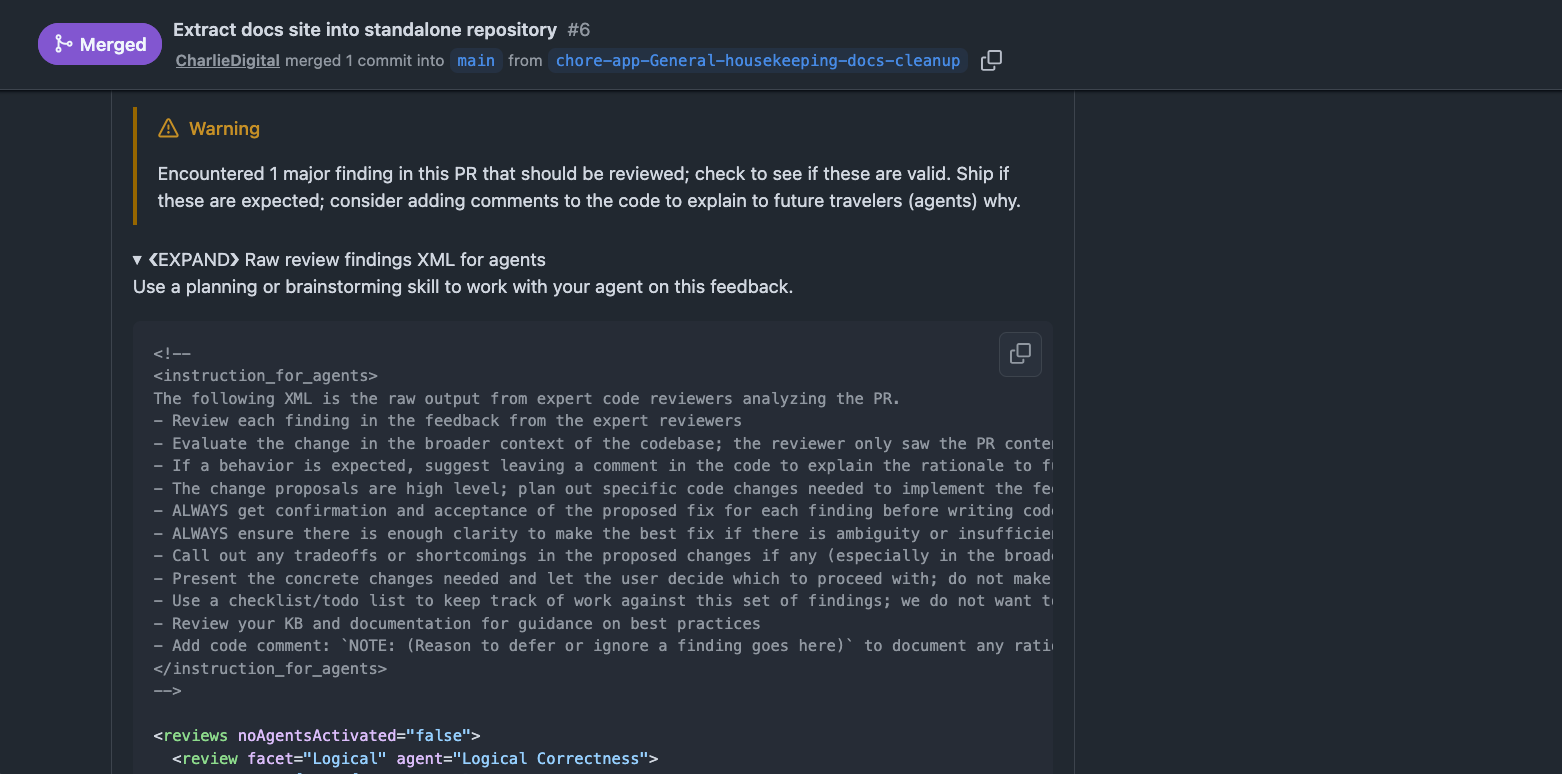
Findings are rendered with instructions and can be copied with one click and supplied to the local coding agent to iterate on:
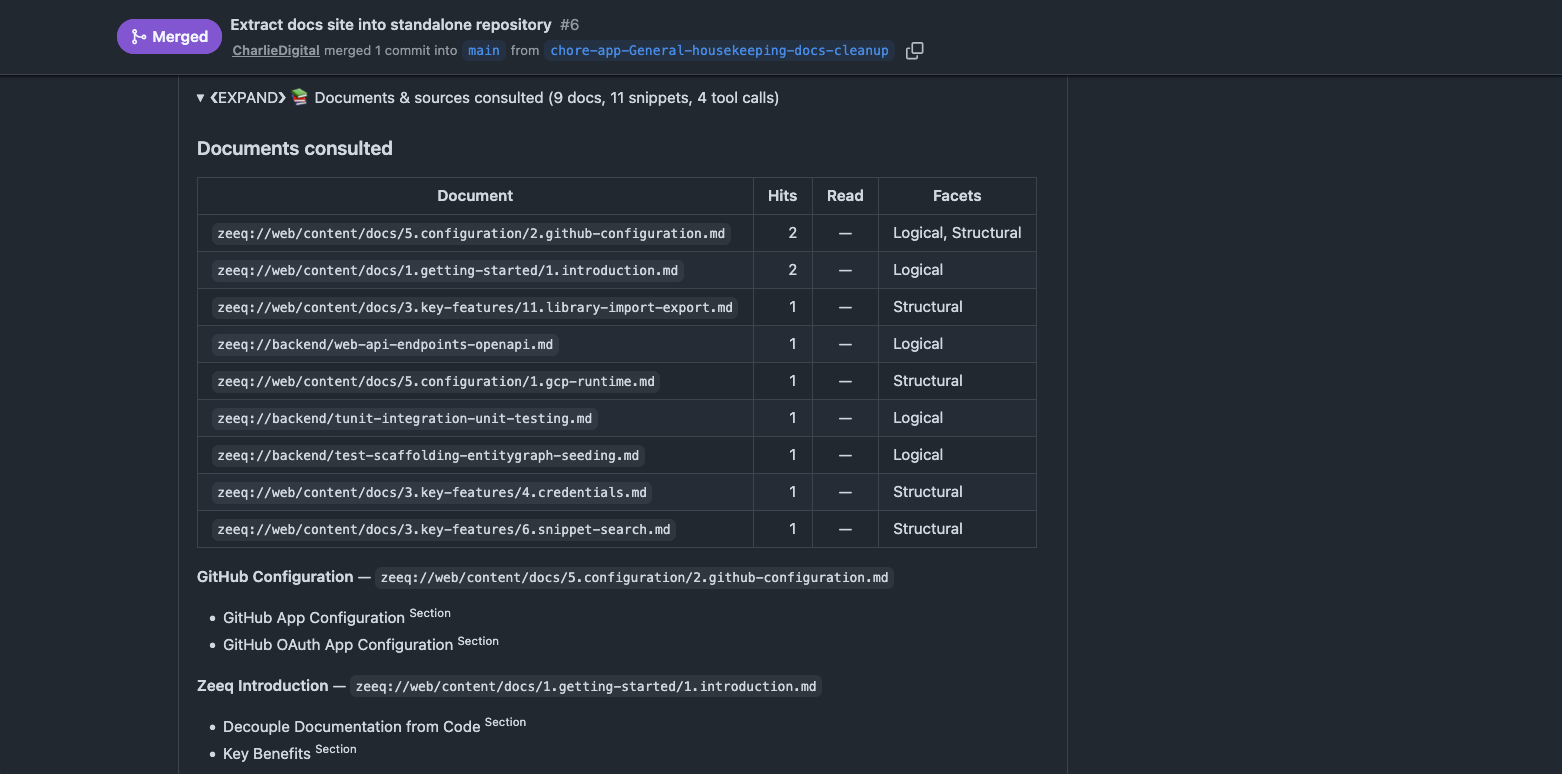
Inline metrics surface which documents and snippets are having an impact on code quality:
Check runs
Each repository can be configured with check-runs on the PR
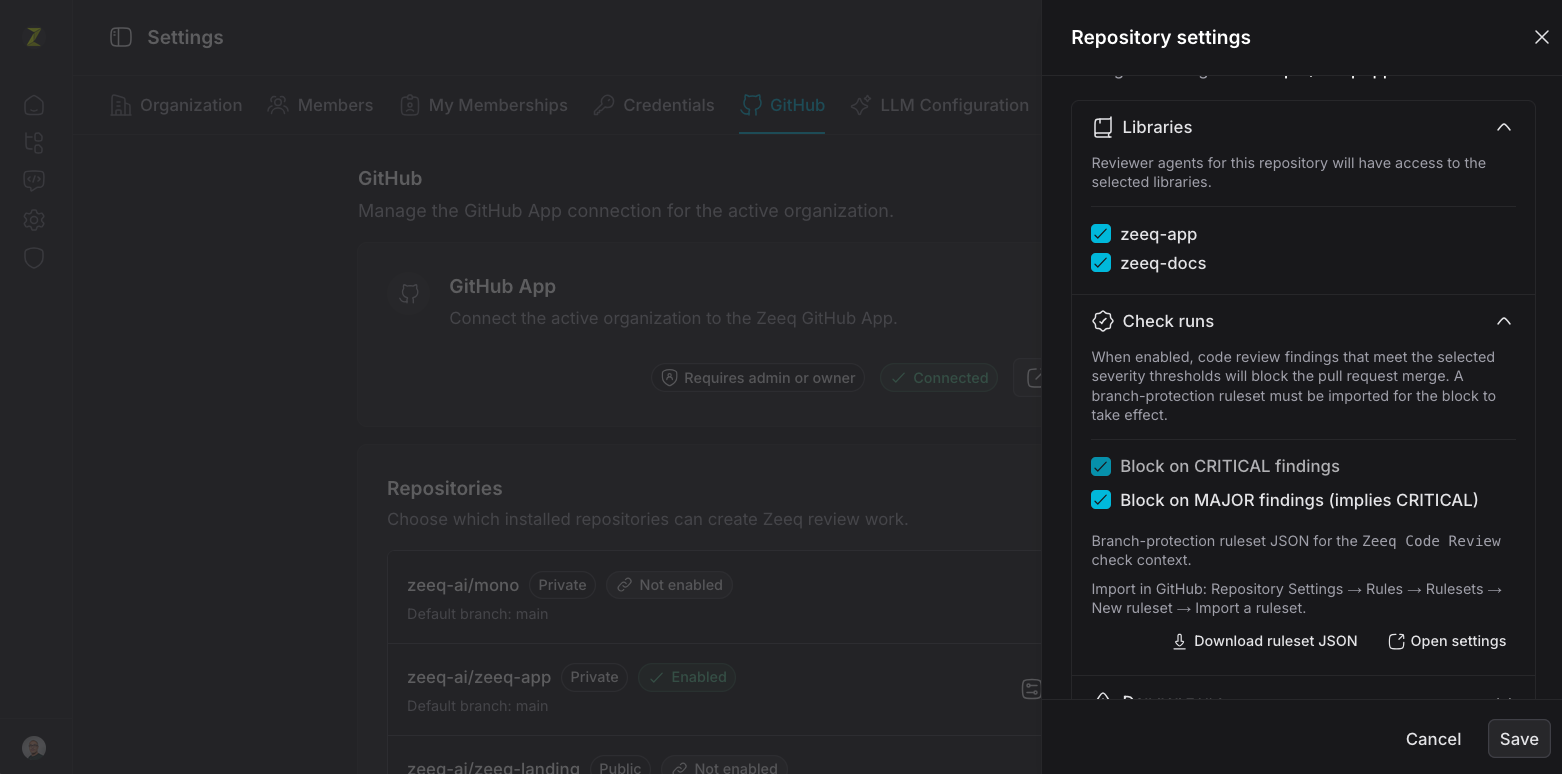
When a PR has critical or major findings, this can be used to put a block on the merge process that can still be cleared manually or by fixing all of the target level findings.
Bypassing check-runs can be done in GitHub directly or via the Zeeq UI for the PR:
Managing findings
Findings can be managed directly in Zeeq in a "PR inbox"
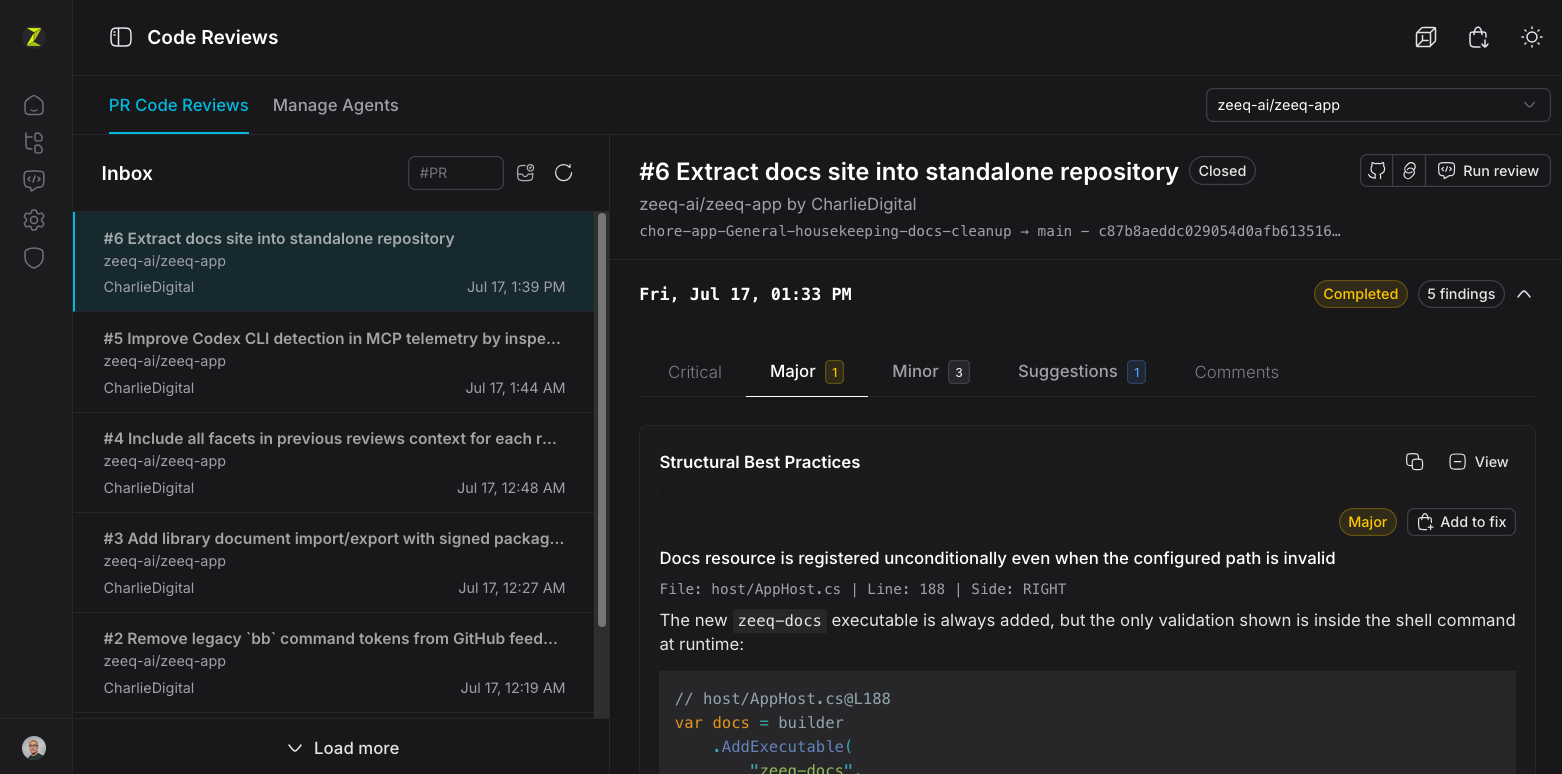
Rather than focusing on code, Zeeq takes an alternative route: focus purely on the findings and deciding "should this be fixed"?
Findings cart
A unique cart-based system for managing findings makes it easy to pick and choose what to fix and when to fix with feedback or custom instructions for the local coding agents:
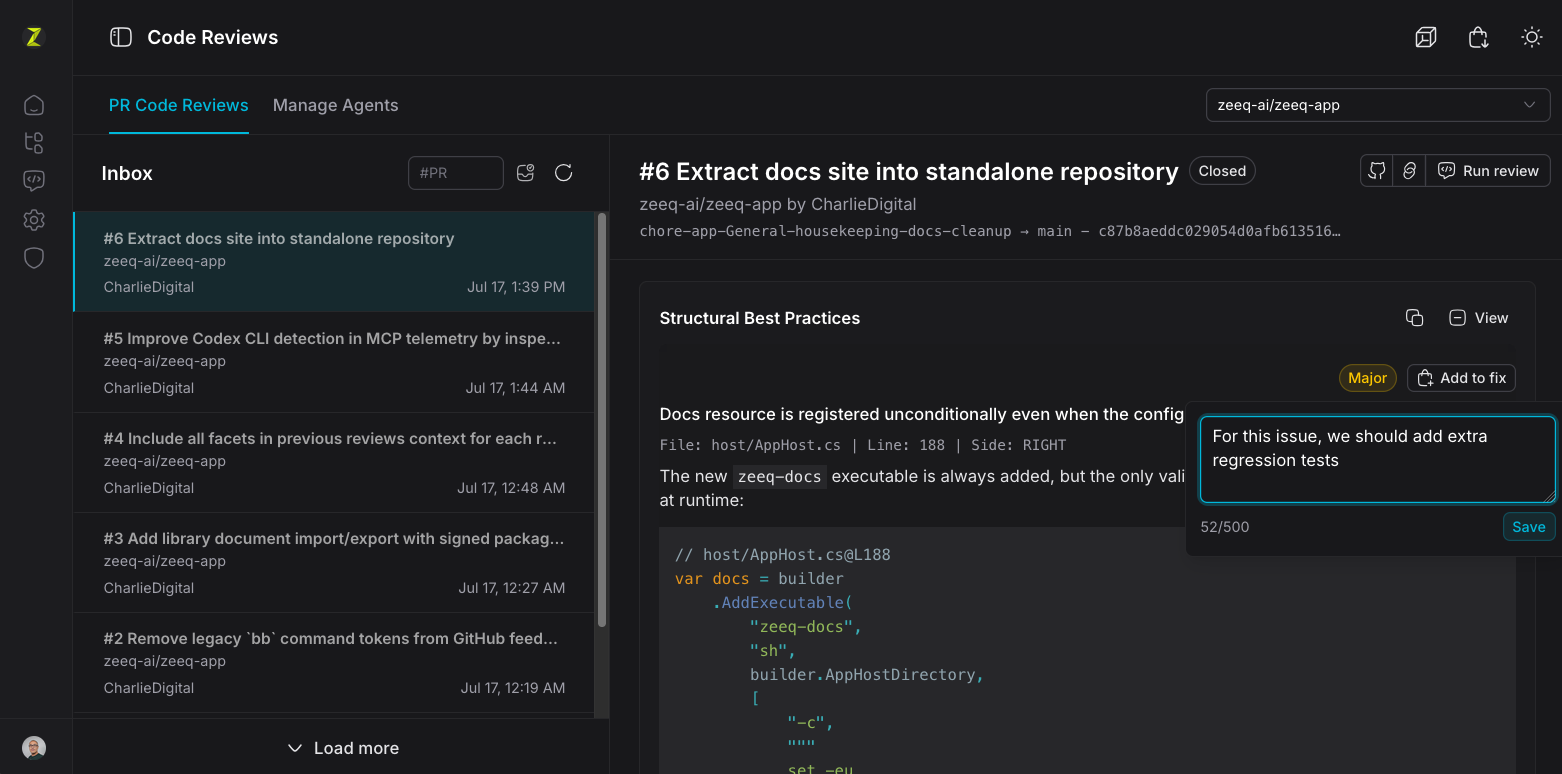
These are added to a cart which can be pulled down and fixed later or even by a different coding agent in a different session.
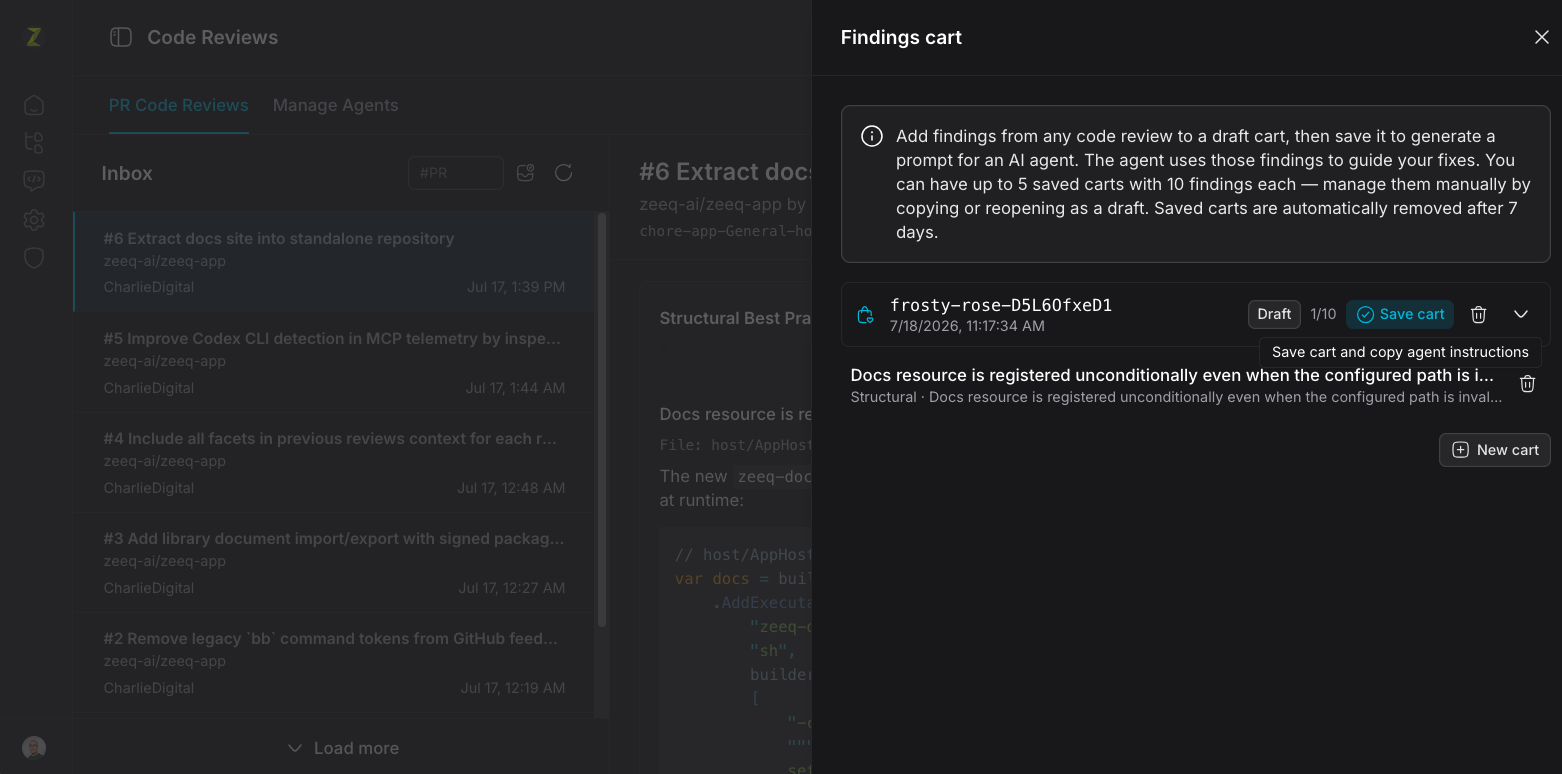
This mechanism lets teams group fixes together, schedule fixes for later, and changes how teams interact with agents and code reviews entirely
When "checking out", a link is produced that allows an agent to read the cart findings and work through applying the fixes.
This produces an instruction that can be given to agents:
Use the Zeeq MCP tool get_cart_findings; retrieve code review findings using cartId=strict-lake-U1s1nDposL.
A few important notes:
- Each cart holds up to 10 items at a time
- Carts are not automatically deleted on use
- Carts are removed after 7 days automatically
- Carts cannot be edited; create a clone and then edit the clone before saving
- Carts can be shared across harnesses and other users in your organization