
Key Features
Summary
Zeeq's features are designed for the agentic coding era. While other tools and platforms offer similar capabilities, Zeeq is focused on bringing those capabilities deep into agent coding loop and help organizations easily achieve higher levels of consistency and agent coding performance.
Indexed Knowledge Library
Problem: I have no visibility into which documents and skills in my repository are useful, which are not, which are having a strong effect on the output of my agent produced code. It's also difficult to keep them updated across my organization because we have some standard best practices and architectural patterns that we want applied to all repositories.
| Capability | /docs | Zeeq Document Library |
|---|---|---|
| Provide static markdown context | ✅ | ✅ |
| Composable and reusable across repositories | ❌ | ✅ |
| Single entry point, multiple sources (GitHub, Notion, etc.) | ❌ | ✅ |
| High visibility telemetry on usage by user, by origin | ❌ | ✅ |
| Indexed and searchable with full-text search | ❌ | ✅ |
| Code examples and sections indexed with semantic search | ❌ | ✅ |
| Instantly updated and synchronized for all projects | ❌ | ✅ |
| Same documents and snippets available in code review | ❌ | ✅ |
Zeeq's indexed knowledge libraries served from a central composition layer and accessed via an MCP tool is a key capability that lets coding agents and the code review agents understand the correct best practices in a codebase.
Rather than reference docs in repo, Zeeq externalizes the content, slices it, and indexes the slices.
This allows agents to retrieve only the slices they need for the task at hand. Agents can read the most relevant sections across your entire corpus and optionally read entire docs as needed.
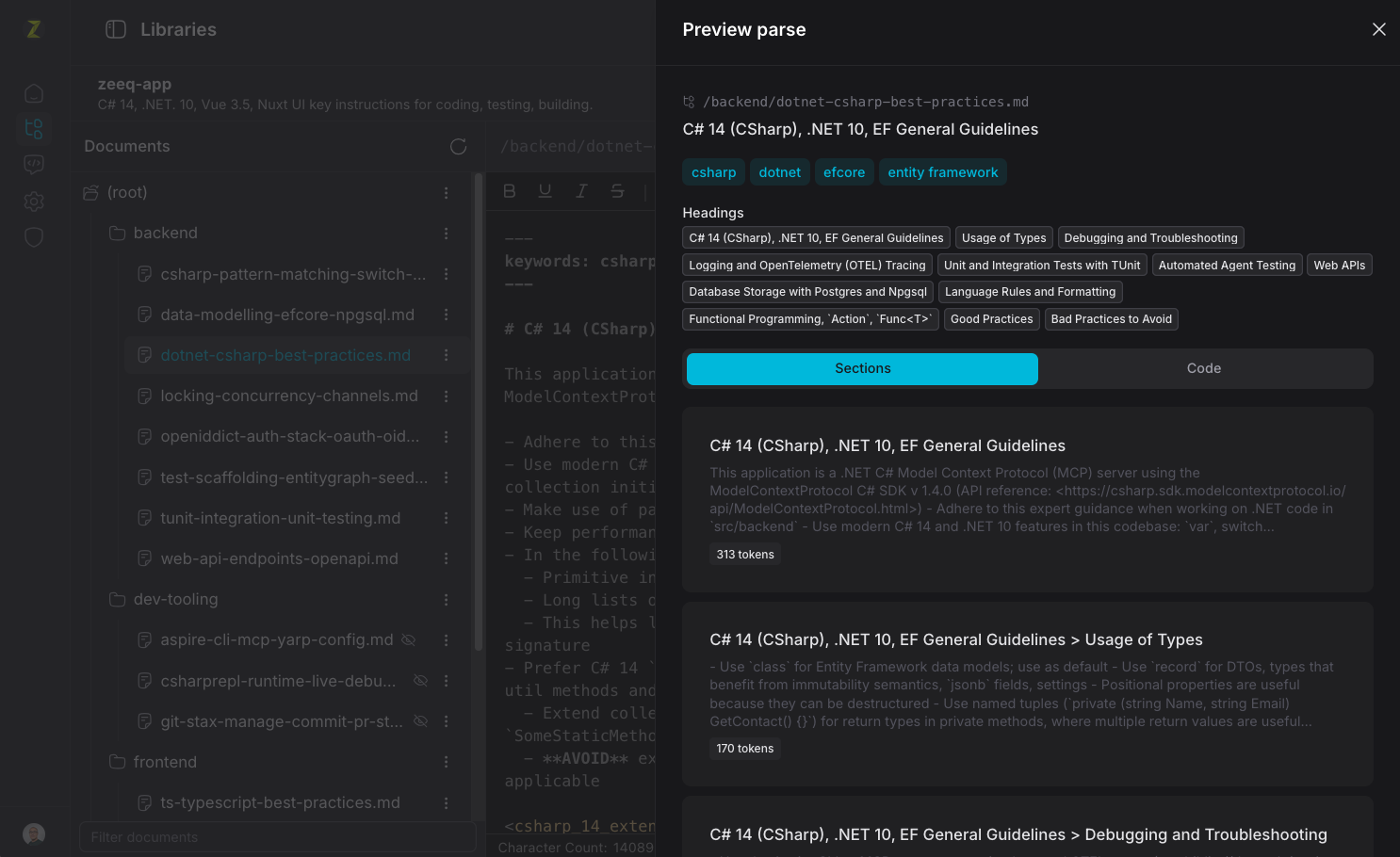
The preview feature lets you see how agents can search semantically across documents by section and code examples to find only the most relevant context for the task.
Code Reviews
Problem: My code reviews are not taking into account our documented best practices and architectural patterns; I want my team's standards and practices to be referenced and applied in code reviews. It would also be great if we could keep code reviews in the agentic loop and have visibility across the team.
| Capability | Other Code Reviews | Zeeq Code Reviews |
|---|---|---|
| Configurable, tunable, concurrent mixture-of-experts | ❌ | ✅ |
| Connected to the same knowledge base used by coding agents | ❌ | ✅ |
| Agent-oriented, findings-focused output | ❌ | ✅ |
| Findings cart to allow operators to pick what and when to fix | ❌ | ✅ |
| Unified telemetry and visibility across the enterprise | ❌ | ✅ |
| Telemetry on source and tool usage for every review | ❌ | ✅ |
| Uses the same PRs to build a world model memory system | ❌ | ✅ |
Because Zeeq has both the knowledge library and the code review tool, it is able to enforce that code follows organizationally documented patterns and practices.
But Zeeq code reviews are built for the agent era: traditional code review tools catch mistakes outside of the agentic loop ex post facto. Zeeq exposes the exact same code review process as an MCP tool which allows local coding agent harnesses to use code reviews as a feedback loop.
Zeeq's approach to code reviews ditches the traditional interface where you look at code; Zeeq focuses on presenting findings and feeding those back into the coding loop with low friction.
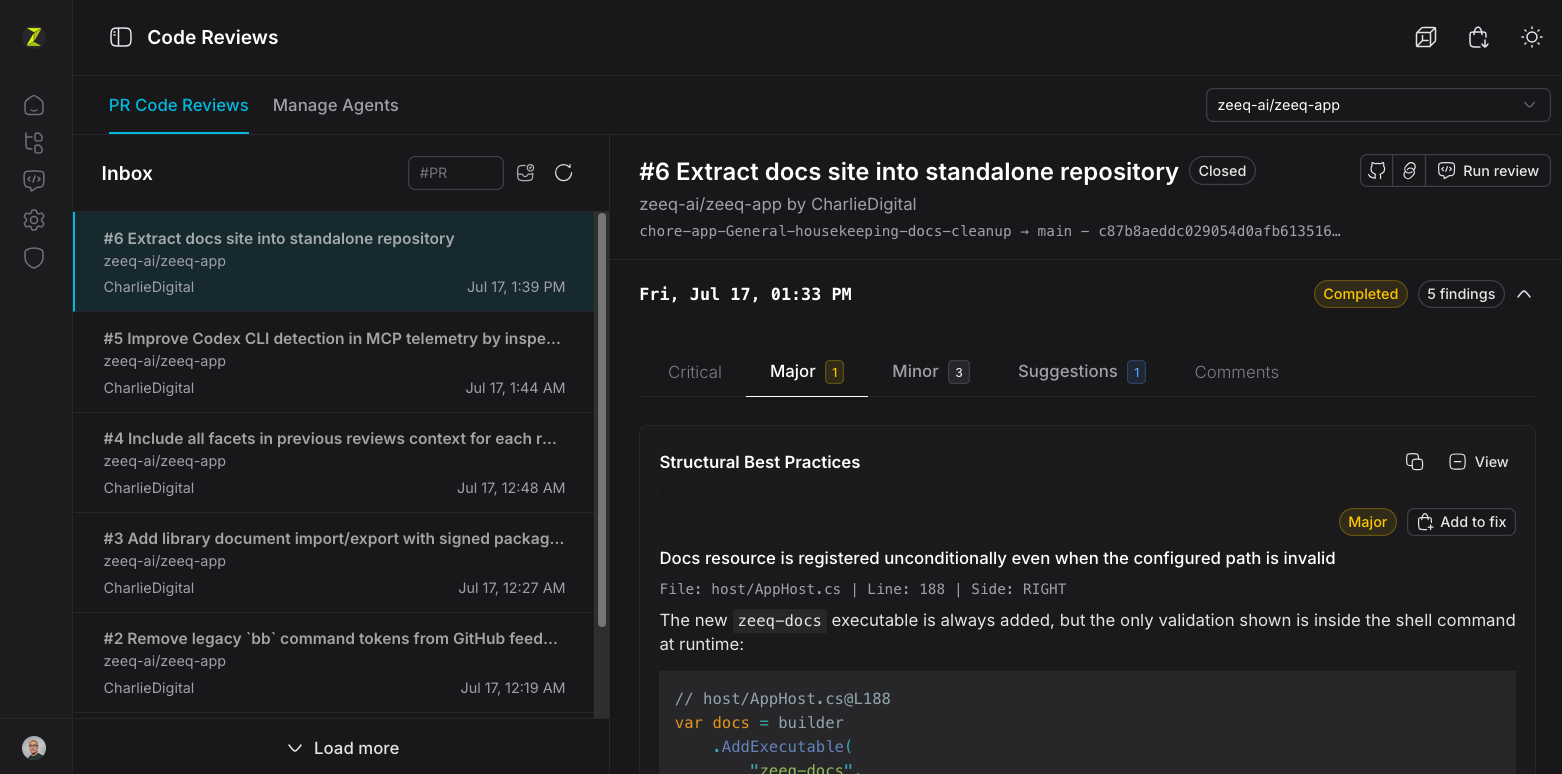
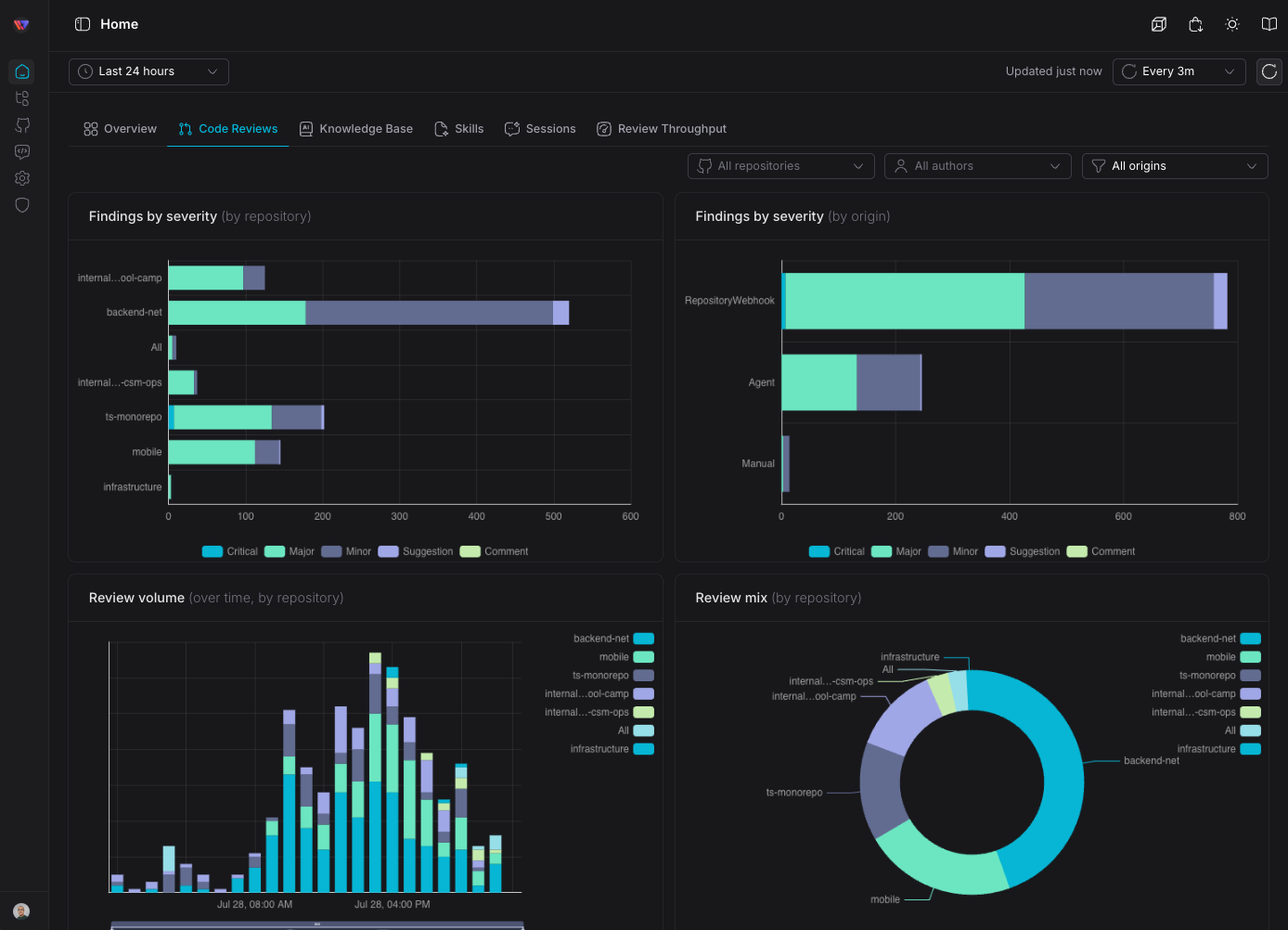
Telemetry lets operators see aggregate statistics on code reviews across an organization:
As well as per-review telemetry on how agents used the documents to produce the code review findings:
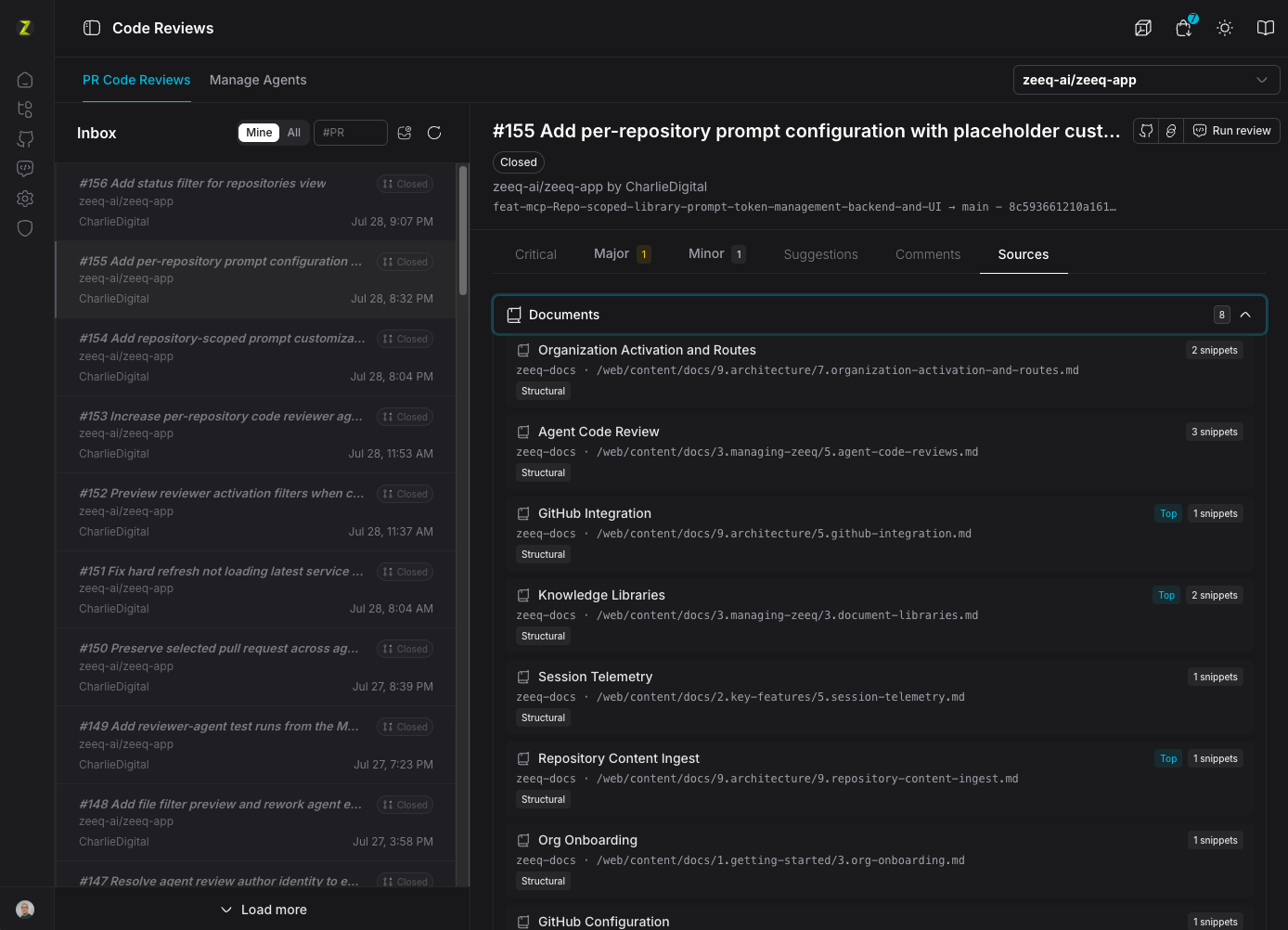
This allows operators visibility and insights into how context directly affects output.
Telemetry and Analytics
Problem: My team is using a heterogeneous set of tools and I want a standard way of reliably delivering context to the various harnesses and agents in my team and see that it's actually working.
| Capability | Other Knowledge Bases | Zeeq Tool Telemetry |
|---|---|---|
| Visibility into actual tool usage and impact | ❌ | ✅ |
| Breakdown by repository, by user | ❌ | ✅ |
| Actionable insights into which documents affect coding | ❌ | ✅ |
| Breakdown on a per pull request basis on how agents reached conclusion | ❌ | ✅ |
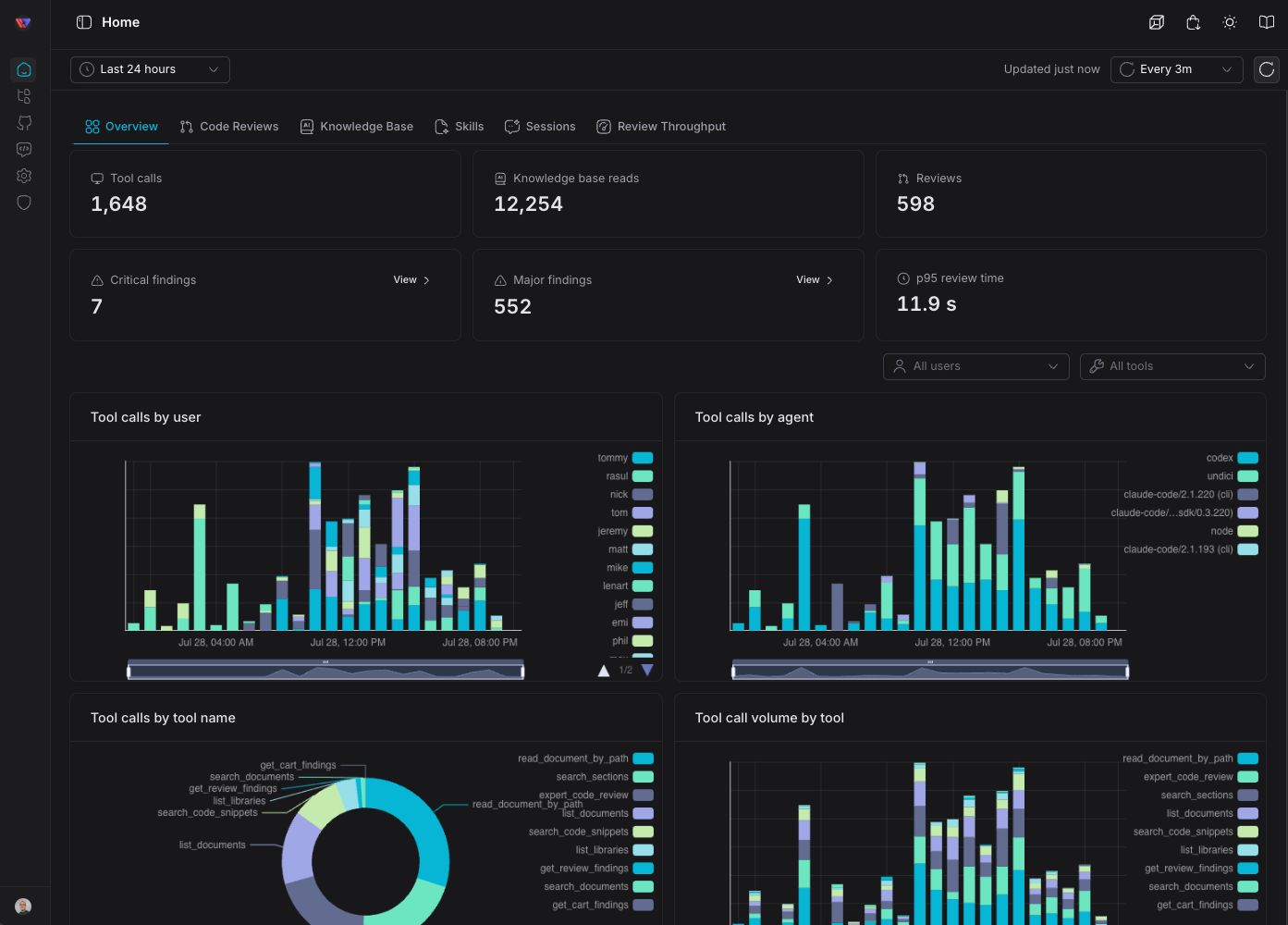
Zeeq helps agentic engineering teams gain visibility into the factors that are affecting code production across a heterogeneous team of product owners and developers using different tools like Claude Code, Cursor, Codex, GitHub Copilot, and so on.
Telemetry and analytics are a core part of the platform and the visibility helps teams identify the key gaps and key areas of focus in the knowledge library.
Session Telemetry
Problem: My team is using a heterogeneous set of LLM providers and harnesses and there's no visibility into token usage, no way to trace it back to delivered value and features, no visibility into what works and what doesn't.
| Capability | Provider Telemetry | Zeeq Session Telemetry |
|---|---|---|
| Unified view in heterogeneous agent harness environment | ❌ | ✅ |
| Works across Codex, Claude Code, OpenCode, Pi, etc. | ❌ | ✅ |
| Links token consumption to actual output and product value | ❌ | ✅ |
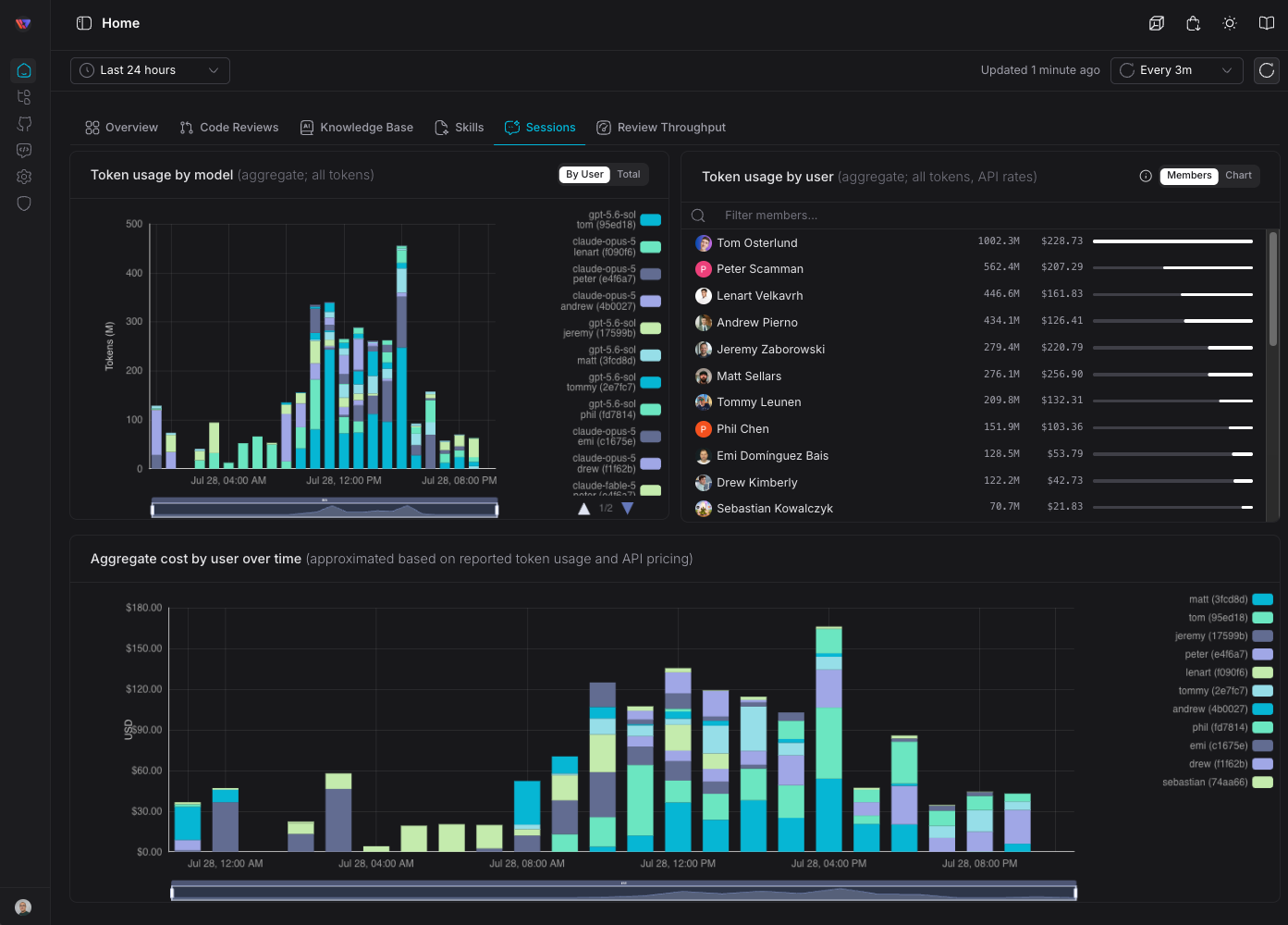
Separate from the tool-level telemetry is the session-level telemetry that captures token usage and links it to an area-feature-action taxonomy in the codebase. This answers the perpetual question for most teams: "where are my tokens going?"
Top level billing information and per-user breakdowns aren't enough; Zeeq's session-level telemetry bridges token usage to actual merged PRs.
Dynamic Skills
Problem: My team has a lot of skills that should 1) share common text between them and be globally applied as standard best practices, 2) be able to be 80% shared, but 15% customized to a team and 5% customized on a developer-by-developer basis, and 3) be able to be updated without having to re-deploy or re-install them. This is impossible when using standard
SKILL.mdfiles!
| Capability | SKILL.md | Zeeq Dynamic Skill |
|---|---|---|
| Static text | ✅ | ✅ |
| Dynamic text per repository | ❌ | ✅ |
| Telemetry on usage by user | ❌ | ✅ |
| Easily deployed across all projects | ❌ | ✅ |
| Automatically updated instantly | ❌ | ✅ |
| Automatically delivered to all connected clients | ❌ | ✅ |
Dynamic skills are delivered as MCP prompts that allow assembly of standard templates into a single skill.
This allows ease of updating behaviors across skills, developers and teams to share skills yet still be able to personalize them, and low-friction updates to skills without having to re-deploy or re-install them.
World Building (2026 Q3)
Problem: I find that agents are constantly missing related files when making changes, often duplicating artifacts left and right, not reusing existing code, and not learning from past mistakes. Even when we document it, we have hundreds of
*.mdfiles in our repo and the agents simply can't find the right ones. The agents also have no semantic understanding of how a feature maps to a codebase and spends a lot of tokens exploring on every new session to rebuild its semantic mapping from product grammar to code artifacts.
| Capability | Harness Memory | Zeeq World Model |
|---|---|---|
| Consistent activation of memory creation | ❌ | ✅ |
| Shared across different team members, different teams, enterprise wide | ❌ | ✅ |
| Provides deep semantic knowledge of the product by area, feature, and actions | ❌ | ✅ |
| Continuously classifies and reorganizes memories | ❌ | ✅ |
| Provides organization wide telemetry and visibility into memory formation, activation, and usage | ❌ | ✅ |
Each PR represents a single set of mutations that are applied to a codebase.
The thesis is that this natural boundary encapsulates a set of related artifacts, entities, and concepts that can be extracted to incrementally build a world model of the product using the codebase. This model maps semantic ideas that are manifest in the code to the underlying artifacts that implement them and allows agents to achieve higher "coverage" of conceptual mapping to source.
In other words, by continuously assimilating the deltas one PR at a time, Zeeq can incrementally build a world model that matches reality and provides agents a "cheat sheet" that helps them do a more complete job, even when given sub-optimal prompts.